Monday, January 5, 2009

Top Ten American Films of All Time

Photobucket

Let me be the first on behalf of the Kula staff to wish you all a Happy New Year! I was perusing through the New York Times and stumbled upon a top ten best American films list written by Stanely Fish. You can read the article here.

Stan's no filmmaker or even film major (he's a law professor), so his picks by-no-means carry the weight of say Manny Farber, but his article did cause me to think of what my top ten list would include. Hence, this post. I have trouble ranking films, so the list will be in chronological order:

Sunrise (1927), directed by F.W. Murnau. I just recently saw this film for the first time, as it's been hard to find until Fox released it as part of a box set. This "song of two humans" is as timeless as they come. Using the classic story of a husband, wife, and a lover, Murnau is able to capture a certain way of perceiving unique to silent films that can only be described as "dream-like." More than just his superb camerawork (which still remains impressive to this day), Murnau's firm grasp of storytelling and character offer rare glimpses into the unseen. He understands the underlying moral order to our lives and God's vested interest in the affairs of humanity.

City Lights (1931), directed by Charlie Chaplin. Chaplin's always going to bring the funny, but this time he brought the profound as well. The story follows Chaplin's lovable tramp as he befriends a rich man and falls in love with a blind girl. Although one of his more serious works, this one's still full of laughs. His interactions with the drunk rich man and of course the boxing scene stick out in my memory. It's interesting to note that Sunrise came out soon after The Jazz Singer, the first "talkie" (read: film with audio), while Chaplin's City Lights was his first film in the sound era. It seems strangely fitting that silent film would produce two of its best examples while on its death bed.

Stagecoach (1939), directed by John Ford. Orson Welles was said to have watched this movie forty times before making Citizen Kane and I can see why. Ford was a pioneer of the classical continuity style that is now used in 99.9% of films made today. The story is based on a famous short story by Guy de Maupassant called "Ball-of-Fat" that's about a prostitute who is surrounded by a band of rich people during a trip through enemy territory during the Franco-Prussian war. Ford doesn't include the scathing critique of French society found in "Ball-of-Fat," but even without its fangs, Stagecoach still includes much of the truth about human nature found in Maupassant's brilliant short story.

Mr. Smith Goes to Washington (1939), directed by Frank Capra. There's an empty Senate seat and the governor of Illinois attempts to auction it off to the highest bidder – wait, no that's not a movie, that's real life. You couldn't make that stuff up, but you could make up a story of a Boy Ranger leader (the Boy Scouts wanted no part of Capra's vision for reform) who is chosen to be a pawn in some dirty (is there any other kind?) politicians' game. Despite all the temptations the world can offer, Jimmy Stewart does the right thing and in the process reminds everyone of what it is to be human.

The Killers (1946), directed by Robert Siodmak. Based on short story by Ernest Hemingway, the film has been made numerous times, in both feature length (Don Siegel) and short (Andrei Tarkovsky) forms. At the center of the film is the mystery behind the murder of a lowly gas station attendant. As the story unfolds, Siodmak gives an acute portrait of desperation, which is no stranger to the noir genre. The film is tragic, but just – everything you'd expect from a good noir.

Rear Window (1954), directed by Alfred Hitchcock. There are many great films by the master of suspense, but none as succinct and unerring as this one. The entire film takes place inside one apartment complex, mirroring the physical limitations of its protagonist, Jimmy Stewart – a photographer with a bum leg. Both parodied and remade by The Simpsons and that hack D.J. Caruso [Disturbia (2007)] respectively, the plot is well-known: a man suspects his neighbor is guilty of murder and attempts to solve the crime by stalking him through his window. The difference between the imitations and the real thing is the impressive economy in which Hitchcock tells the story. One of the few perfect films ever made.

The Searchers (1956), directed by John Ford. His second film on the list is one of the greatest westerns ever made. I debated between including this or The Man Who Shot Liberty Valence (1962), as it's been a while since I last saw either film, but I knew that one of Ford's westerns after Stagecoach (1939) deserved to be included. Ford knows westerns and John Wayne was made for them. I appreciate the moral ambiguities this time around; as good and evil are never as clear as they seem to be. I also cannot not to mention the incredible cinematography. The visual lyricism achieved in this film is unparalleled in most westerns, let alone most films. The intro scene with the doorway definitely comes to mind.

The Ten Commandments (1956), directed by Cecille B. DeMille. When the Bible is done right in film, it's an extrodinary thing. DeMille was once quoted saying something along the lines of, "Give me a page out of the Bible and I'll give you a film." He took one of the greatest stories ever told and gave it new life. The scene where Moses unknowingly saves his birth mother is one of the most touching illustrations of mercy committed to film [the other being in Kurosawa's High and Low (1963)]. Although the scene is not in the Bible per se, it is definitely in the Spirit of the words and reflects the Truth found in the book. I think no higher praise can be given to a film.

Ben-Hur (1959), directed by William Wyler. Of course the famous chariot race scene comes to mind, (which I think is still one of the greatest action set pieces of all time) but what's at the heart of the film is a story of a man trying to preserve his soul despite having all the evils of the world poured out in his path. In a way his story echoes that of Christ's, as the Son of Man met great opposition to save every soul, ultimately overcoming death and overwhelming the grave. I guess that's why the tagline of the film is "A Tale of the Christ."

Badlands (1973), directed by Terrence Malick. What's more American than murder? Terry Malick's portrait of a murderer is unique in its objectivity to subjectivity. He was quoted as saying that Kit (the murderer) used his gun as a magic wand to make his problems go away. This child-like logic is not unlike the dream-like logic I refered to in my review of Sunrise. There's something very pure and very lyrical about Malick's portrait of the murderous youths that creates a certain empathy without resorting to the lazy psycho-babble present in lesser works like Rebel Without a Cause (1955).

When making this list, I was tempted to include more frivolous affair like The Raiders of the Lost Ark (1981), but I think there is something to be said about the films that reveal what is timeless about our experience here on earth.

TO READ THE FULL POST WITH COMMENTS, CLICK HERE

Monday, September 8, 2008

Dziga Vertov Group's Schick Commercial


1971. Color. 53 secs

Jean-luc Godard and Jean-Pierre Gorin signed an advantageous contract with the Ad Agency Dupuy-Compton, they got paid as long as they propose a project per month and to shoot one of those ideas at least once a year. For this Schick commercial, they obtained the budget to pay for a week's worth of production but only took half a day to shoot the thing. Who knows what they used the rest of the money for.

TO READ THE FULL POST WITH COMMENTS, CLICK HERE

Wednesday, August 20, 2008

Manny Farber and All That Jazz


Just wanted to share this very insightful and distinct look into Manny Farber. Written by JP Gorin for the Manny Farber tribute which was held at Atkinson Hall (UCSD) on May 13th 2006.


At the core of this evening, a few simple precepts:

1. It is impossible to reconcile the name Farber and the word ‘tribute’ and the absurdity of heaping praise on such an artful cliché-dodger is self-evident. Yet once this impossible mandate has been accepted, apply to Farber’s work his own critical medicine: burrow into the work, extend the evening, collaging it with pace changes, multiple tones, and get as many different voices into it as possible.

2. Let the paintings be seen. Let the paintings be seen. Let the paintings be seen. Camp at Calit2. Make massive use of digital technology. Sacrifice as many animal farms as possible to this often inclement God, cross one’s fingers for computers not to crash, for smooth transitions and change-over, and savor the irony of using 4k wizadry to further the understanding of someone who is fundamentally a quill and ink, scissors and paste guy.

3. If and when the machine breaks down, remain persuaded that the evening would then achieve a true “Farberian” gait. In short, use whatever happens to endorse the be-bop dissonant harmony inherent to so many of Farber’s written and painted pieces.

4. Reset the clocks. Manny Farber is not a film critic who renounced film criticism and switched to panting. The absurd condescension that puts a hobbyist tag on Farber’s work simply denies its uniqueness. Farber is this extraordinary case of someone equally fluent in two practices, painting and writing, that inform and modify each other incessantly. It is his existence at the confluence of these two practices that makes his work so layered, contradictory, polyphonic. In short, a.l.i.v.e.

5. Reset the clocks. Manny Farber is not a film critic. To see him as a film critic is as absurd as seeing the philosopher Gilles Deleuze as a film critic when he writes Cinema: The Movement Image or The Time Image. Deleuze thinks via films through some fundamental problems raised by his practice as a philosopher. Farber is a painter and a writer who turned to film because film allowed him to ask and solve some fundamental questions raised by his practice as a painter and a writer. In short, thank you very much, like Walter Benjamin and a few others, Farber is a child of the century.


6. Reset the clocks. Manny Farber’s paintings are NEVER homage to the films or film directors he analyzed. They are always a meditation on how a film practice that essentially defines the function of the image as passage and disappearance could transform the practice of painting that has traditionally defined the image as appearance and fixity. Lo and behold, the meditation paid off: looking at a Farber painting is to be seduced and trapped by systems of motion.

7. Reset the clocks. Manny Farber is not a diaristic painter. By this account Cezanne would be sent to the same hell for painting apples or traipsing to the Mont Saint Victoire. A handwritten note on the canvas is not simply a laundry note (however witty, cryptic, etc.) but an enticement to read that gets frustrated by an upside-down placement on the canvas, its half erasure, or simply the nervousness and speed of the trace. Speed, speed, speed, at all cost… style, style, style over content any time of the day.

8. Reset the clocks. There is a fundamental playfulness and a pervading sense of pleasure that every inch of a Farber painting or article communicates. Try to get some of it on the way this evening will function. As Farber would say, “Go for tricks.”

9. Reset the clocks. One of the glories of Farber’s work is that exists as a result of his constant interaction with the painter and writer Patricia Patterson. Stress how essential she has been in the elaboration of the Farber machine (choices of colors, patterns, words, sense of when a piece of writing or a painting has gelled and needs to be left alone). Risk the hypothesis that one should talk about Farber/Patterson as one talks about Straub/Huillet.

10. Strive to create an evening that does not only talk about Farber, but functions as a Farber, and leave the audience with this sense, diffuse or clear.
-- Jean Pierre Gorin

TO READ THE FULL POST WITH COMMENTS, CLICK HERE

Tuesday, August 19, 2008

Manny Farber, 1917-2008


This is awful news not just because Manny Farber is arguably one of, if not the best American film critic but I know a really good friend of his that is probably taking this pretty hard. It was disappointing knowing that I missed his lectures at UCSD by a couple of years but I take pleasure in that the DVDs I copied somehow made it to him.

08.18.08
Manny Farber, an American painter and film critic, has died. A contributor to the New Republic, Time, The Nation, Film Comment, and Artforum, Farber’s reviews of and essays on films were compiled in several collections, including Negative Space. An early champion of American B movies, in 1962 Farber coined the phrase “termite art” to describe art that “seems to have no ambitions toward gilt culture” and “leaves nothing in its path other than the signs of eager, industrious, unkempt activity.” Susan Sontag once said, “Manny Farber is the liveliest, smartest, most original film critic this country has ever produced . . . [his] mind and eye change the way you see.” As a painter, Farber was as restless as the films he championed in his writing, and moved from abstraction to narrative work in the 1970s and '80s. A retrospective of his paintings originated at the Museum of Contemporary Art San Diego in 2003 and traveled to the Austin Museum of Art and the P.S. 1 Contemporary Art Center in New York. Farber’s art is in the collections of the Los Angeles County Museum of Art, the Museum of Contemporary Art Los Angeles, the Museum of Fine Arts, Boston, the Solomon R. Guggenheim Museum, and the Whitney Museum of American Art.

TO READ THE FULL POST WITH COMMENTS, CLICK HERE

Wednesday, June 18, 2008

Chris Marker Store (sort of)

fourmarker.jpgfourmarker1.jpg


Chris Marker has his own store...

And is selling 4 previously unreleased essay films. Though the official street date for these DVDs isn't until 2 September, Icarus Films has allowed the Wexner Center for the Arts exclusive pre-release sales of these titles via their Chris Marker Online Store.


TO READ THE FULL POST WITH COMMENTS, CLICK HERE

Tuesday, June 10, 2008

What happened to my peurile dream?

When my friend John said that I should write for this blog, I got really excited. I've been meaning to start one, to dedicate to fashion. He said the blog is intended to discuss about art and film, I was disappointed for a sec. Then I realize I was once passionate about film, still am but more of an admirer rather than a contributor. What happened...

Before I graduated from UCSD, I dreamed of becoming a kick-ass female film director (yes, exactly that description). I would be directing music videos in flavor of Let Forever Be by Michel Gondry and independent films like Run Lola Run, Amelie, Real Woman have Curves, and Saving Face. I once quoted:" I want to marry Michel Gondry's brain." and Alice Wu (director of Saving Face) was my idol. Michel Gondry is so innovative and Alice Wu is just inspirational! She went to school for computer science, worked for Microsoft in Seattle then switched her career path to film when she turned 30. She wrote her script in two weeks and sent it in for a contest. Why wouldn't that be inspirational. Though some parts of the Saving Face was cheesy, but she really captured the essence of a bi-cultural family, grandparents included.

I wanted to work on films about
love, becoming-of-age stories, new age females, my thorn-in-the-butt parents, bi-cultural experience(done the right way), the after effects of politics on life and of course it has to have kick-ass music to accompany with.

I never got interested in film till I had to take film classes for my prerequisites in college. I was introduced to various arty films around the world and I got molded into thinking about how every angle was shot when watching a film.Then I got to make my own little film projects for my media classes. I thought,"Forget about graphic design," - not that they teach you anything about "Design" anyway. :/ I even had the opportunity to study Spanish Film in Madrid - the best summer ever and now I know everything about Pedro Almodovar.

To be continued...


TO READ THE FULL POST WITH COMMENTS, CLICK HERE

Wednesday, May 14, 2008

Watching a Todd Hayne's film? I'm not there...

Photobucket


Back in December, I had the choice between seeing Before the Devil Knows You're Dead and I'm Not There. A part of me always regretted choosing Before the Devil (see post), but after watching Todd Hayne's latest biopic, I now realize I should have gone home that night.

Alternating between campy and cryptic, the film suffers from tonal inconsistencies. One moment you're watching "Arthur Rimbaud" at a McCarthy-esque hearing, the next you're in the middle of a Christopher Guest film with Julianne Moore pretending to be Joan Baez. In one word: senseless.

One could make the argument that Haynes is trying to make the filmic equivalent of a Bob Dylan song with its cobbling together of various pop culture references. The only problem is that Dylan's a much better songwriter than Haynes a filmmaker.

Every cloud has a silver lining and in this case it comes in the form of Cate Blanchett's performance as "Jude Quinn," the Pennebaker Don't Look Back Dylan. At one point, she's attacked by a disgruntled fan while her entourage stands back in fear. Before she's stabbed, some blonde chick brakes a vase over the head of the would-be attacker. Cate responds, "Just like a woman." There's just something very funny about a woman being a man being a misogynist.

TO READ THE FULL POST WITH COMMENTS, CLICK HERE

Thursday, February 28, 2008

Wes Anderson's New Masterpiece

Photobucket


I'm not even going to bother searching for a cap for this film. T (or Joe, if you're still around), you guys can put in a screen shot if you want.

15 minutes in I found myself booting up Contra 4 on the DS. An hour later, I came to two conclusions: 1. The machine gun is the best gun. Ever. 2. The Darjeeling Limited is bad in every way that Contra 4 isn't.

TO READ THE FULL POST WITH COMMENTS, CLICK HERE

Sunday, February 10, 2008

Quite a City

Photobucket


The other night me and the gang went on an aimless and ultimately fruitless journey into the heart of Silverlake to see all the fun we've been missing out on living in Walnut. Apparently there's not much.

Other than some tight pants and hoodies I can't say life's much different place to place, yet I've been noticing this flight of the young and anxious to places like NYC or Frisco. It reminds me of this Bruce Springsteen song that goes something like, "There's something happening somewhere, baby I just know that there is."

Unrest is a funny thing. I was watching the new mumblecore darling Quiet City and it almost fooled me into thinking New York was the place for me. Something about brick buildings and bookcases stir the soul I guess.

The film's not bad. I can describe its success in one word: humble. John said something about how Away From Her worked best when the director stopped trying to be a filmmaker and just let it happen. The same could be said of Quiet City. There's some loose, yet elegant form going on like having a loud and raucous score play over the title "Quiet City" that's nothing to write home about, but effective in its simplicity.

I saw Belle de Jour for the second time earlier this week too. I appreciated the sound design much more this time around. All those bells and meows reminded me of something I forgot about. I think I should take breaks from watching only the masters though. Sometimes something contemporary can serve as a nice reminder of setting the bar a little lower.

A humble film will be my next film.

TO READ THE FULL POST WITH COMMENTS, CLICK HERE

Sunday, December 30, 2007

The Kula is NOT dead. (It's just resting.)

Don't Die Kula!


So I just came back from my church's winter retreat and what did I find on my living room table but the new Radiohead album box set I ordered a while back. I can't really say that I wanted the box set, but the guilt from downloading the album for free was too much to bear. Now that it has arrived, I'm very glad for my guilty purchase.

Back when I first stumbled upon the benefits of vinyl, I came to this epiphany about how the act of flipping a record changes the way an album is digested. Since there's only a finite amount of physical space and no way of making grooves smaller without losing quality (ie mono), each side of a record is limited to around fifteen minutes. (This is just a tangent, but the first track "15 Step" may have been titled after this fact.)

Anyway, so here I am listening to In Rainbows on vinyl and it's like I'm listening to a whole new album. In addition to the digestion thing, there's this degree of separation you can hear on vinyl that you can't on mp3s or even CDs. I think it's because of how the encoding on CDs (and even more so in mp3s) takes some sound out of original recording to shrink the size of the file. I'm no techie, but it has something to do with if say a guitar makes one sound that overwhelms the other instruments, the encoder just takes out those instruments because in theory you can't hear them anyway. But as in most things, theory is just not reality.

So yeah, the degree of separation is so great that a lot of sounds I chalked up to be electronic instruments were actually revealed to be guitars. Makes me realize the full extent of their appropriating electronica tropes for the purpose of rocking out.

I wish everyone still had record players and could hear what I hear, but since we don't, a good way to at least get the digestion effect is to listen to the album in the following intervals:

15 Step
Bodysnatchers
Nude

Weird Fishes/Arpeggi
All I Need
Faust Arp

Reckoner
House of Cards

Jigsaw Falling Into Place
Videotape

So there you have it. If you take pauses in between these intervals, you'll notice a clear order to the tracks that I feel is otherwise absent in a straight-through (ie CD/mp3) listen. If you're a believer in the idea of music as a sonic experience/soundscape then you'll appreciate this new way to say hooray.


TO READ THE FULL POST WITH COMMENTS, CLICK HERE

Wednesday, December 19, 2007

Remember Who We Are

This is the Kula


Below is a link to my most recent short film. It was commissioned by my pastor to help promote our ministry's 2007 Winter Retreat.

The synopsis:
A young man's faith is tested when he finds his home ransacked by burglars. Tempted by vengeance, he is given a chance to catch the thieves responsible. Does he act on his desire for revenge or obey Christ's command to forgive?

http://video.google.com/videoplay?docid=-7844876116158047352

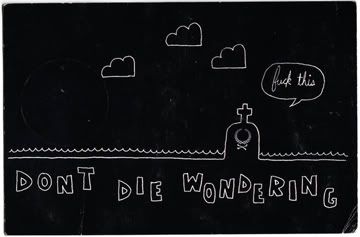
I also did some graphic design work for the retreat. Below is the front of a postcard we sent out to raise awareness.

Come to the Retreat


If anyone reading this is interested in attending, there is still time to sign up. The dates are December 28-30 and the cost is $75. Contact thelo4him@yahoo.com for more details.

Enjoy the film.

TO READ THE FULL POST WITH COMMENTS, CLICK HERE
Wednesday, December 5, 2007

Before The Devil Knows You're Bored

Don't look at me!


Expectations were high going into Saturday night’s ten o’clock showing of Before the Devil Knows You’re Dead. With clichés like, “A return to form” being thrown around, I couldn’t help but be hopeful. So hopeful in fact, I too jumped on the cliché ridden bandwagon to convince a certain movie-hating (but television loving) friend of mine to see the film.

Boy was my face red. A more apt cliché for the film would be, “A disappointment.” Now I agree with fellow Kula contributor John Lin that somewhere in there is a better film, but as the old adage goes, “Almost doesn’t take it to the bank.”

I find writing negative reviews difficult because I believe failures in form are symptoms of a greater failure in content, and Before the Devil is no exception. The film is born of contempt, not only for the characters, but for the viewer and humanity in general.

Before the Devil has been described as “a Greek tragedy” and to some extent the glove fits. Somewhere in the film a family destroys itself, people die, and everyone is flawed. Now I’m not asking for sunshine and rainbows, but I am asking for an even handed depiction of the world we live in.

There is a certain perspective to tragedy and to a greater extent the world, that can be best be described as "classical" or "mythic." In Greek tragedies or Shakespeare or even No Country for Old Men, there is a sense that what you are perceiving is not so much a random occurrence or the mere result of the actions of man, but instead the movement of forces unseen. There is a timeless quality to these forces, that they have been here long before and will be here long after us.

Someone once said, "We do not speak, but are spoken through," which I was reminded of while reading the following passage of War and Peace earlier today:

Pierre first wanted to sit somewhere else, so as not to inconvenience the lady, wanted to pick up the glove himself, and to bypass the doctors, who were not standing in his way; but he suddenly felt that that would be improper, he felt that that night he was the person responsible for performing some terrible rite which everyone expected, and that he therefore had to accept services from them all. He silently accepted the glove from the adjutant, sat down in the lady's place, putting his big hands on his symmetrically displayed knees in the naive pose of an Egyptian statue, and decided to himself that this was precisely as it had to be and that that evening, so as not to lose his head and do something foolish, he ought not to act according to his own reasoning, but give himself up entirely to the will of those who were guiding him.

With the right perspective, joy or sorrow can be understood by their cosmic purposes and its my belief that the purpose of all art is to transmit this level of understanding. In contrast, art made from a humanist perspective will instead transmit a confusion that takes an apocalyptic stance on tragedy and propagates an unforgiving opinion of the shortcomings of others.

From the first frame on, Lumet’s humanist intentions are clear. He shoots Andy (Hoffman) and Gina (Tomei) very graphically 'getting it on,' with Andy more interested in his own reflection than the lovely Tomei. Post-coitus, they muse about this half-baked dream of moving to Rio until Gina mumbles some wifey comment that brings their fragile happiness to a grinding halt.

What you can judge about the characters from the opening scene is just about all you're gonna get for the rest of the film's two hour running time. Devoid of any real insight to their objective identities or subjective experiences, the film prefers to hit you over the head with how depraved and pathetic these people are. It's as if Lumet wants to coax your wrath to a fever pitch until showing their destruction as some sick form of catharsis.

The last shot in the film is of the father walking down a hospital hallway after killing his son Andy. The aperture opens up until the frame is blown out from the light entering the windows, connoting some idea of divinity or heaven. A fitting end to a film bent on condemnation, glorifying a man who showed no restraint over his contempt, killing the jerk we’ve been watching mess up his and everyone else’s lives for the past two hours.

Formally, you can always question the chronologically mixed structure as well as the awkward flicker fading between each vignette. Add into the mix a bunch of unnecessary zooms and exposed breasts, and you have yet another example of a film senselessly pandering to philistine ideas of entertainment. If Lumet were either a little more sincere or had a bigger budget, we’d be seeing explosions.

TO READ THE FULL POST WITH COMMENTS, CLICK HERE
Monday, December 3, 2007

Am I too late for the party? I brought chips!


Sydney Lumet’s films often represent themselves as a zoo for the criminally mad, a zoo populated by caged and desperate men grappling with themselves and the law, usually losing to both; crime films as tragedies as pulp. As devoted as he is to the Genre, make no mistake, Lumet is a man of the melodrama. From Howard Beale’s enraged plea of desperation for us to get up from our chairs and to get mad, to Sonny’s anguished stand off in the name of love, his are films indulging in the consequences of human error from human despair, the inevitable tragedy of voluntary choice. Which brings us to Lumet’s newest offering, “Before the Devil Knows You’re Dead”, a paradox of qualities that frustrate as much as it intrigues.


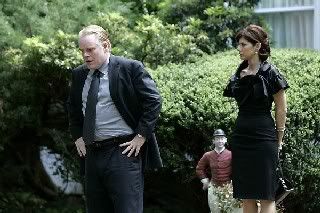
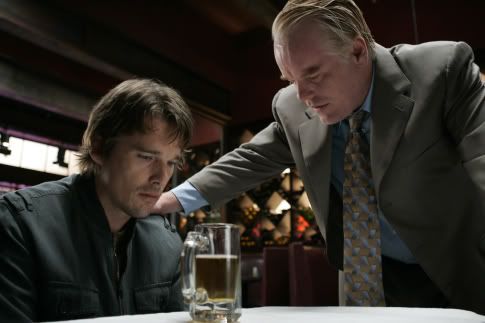
“Before the Devil Knows You’re Dead” lurks around in the shadows of a guilt ridden crime drama, insincere as much as it is crushing. Andy, played as cross between Jerry Lundengaard and Gordon Gekko by the always nifty Phillip Seymour Hoffman, is a man who “knows all the angles”, intelligent enough to recognize his desperation but too dim witted to maneuver around them. Andy’s brother, Hank, played annoyingly as ever by Ethan Hawke, is a worn down pair of jeans, heavy with tear and etched deeply with the burdens of his own impotence. The two brothers unlike in appearance but almost identical in distress hatch a plan to rob a jewelry store, a mom and pop outfit (HA! LITERALLY! HA!). This is a fool proof plan, until “it all falls apart”. There is death, there is guilt, there is anguish; this is where the film builds its walls, surrounding itself with the permutations of time, reflections of what Andy and Hank and the rest of their fucked up family must atone for.

This is exactly what makes “Before the Devil Knows You’re Dead” interesting; the dynamics of personal politics between the two brothers, their family and basically every other character in the film, especially Andy and his wife, Gina (Marisa Tomei), an ennui stricken trophy wife, a sex pot teetering tentatively between come hither gestures and doe eyed innocence. 

The film opens with Andy and Gina on vacation, fucking in a hotel room encased in mirrors. Their sex is bathed in an orange light, Andy’s body rotund and awkwardly confident, Gina, euphoric with passion. This isn’t sex, this is fucking, this is release, this is the 30 minute head start to heaven that one hopes for before the devil knows we’re dead (the original phrase that the film takes its title from). Lumet knows to understand Andy, we need to understand Gina, not as a character, but as an object of fantastic/fatalistic desire. As she dwarfs in and out from Andy’s body, the camera moves tentatively away only to be sucked back in by Tomei’s wrestling of the sheets; he plays to Tomei’s persona and body. We understand what makes Andy want to rob a jewelry store to take her to Rio de Janeiro, to escape to a fantasy where 30 minutes is time enough to escape the devil, but not sexually. Sex is the means for us to compare, to take the evidence of Andy as a pathetic figure from the word “fuck” and to see that Gina, although equally despicable, will be the best he will ever see and as such, he NEEDS her love, needs to hide it from the world and most probably himself. We need to see Andy’s fat ass, we can’t escape from it (literally). Lumet plays this scene and every other scene between the spouses with a certain calculation that he loses in other scenes. Witness the break down of Andy in the car. Gina sits next to him, helpless and barring on indifference. Lumet shoots it strictly as a parallel gesture, never allowing the frame to reveal a two shot sequence; it’s never shot-reverse shot. Although standard issue tactics, it nonetheless provides a glimpse into what Lumet wants, which is at least a modicum of technique that seems so absent from today’s craftless fare. But perhaps the most accentuated, concisely diluted scene in the film is the scene when Tomei leaves Andy behind, her listless body nestled into the corner of the screen, Andy walking through the shot, so indulgent in his guilt and desperation that he is completely oblivious to her presence. Lumet’s camera lingers with Tomei, holding back, as Hoffman goes in and out of the bathroom washing his face. There it is, there is where all the praise lavished on the film lies. The silence of departure, the hope for atonement. Lumet doesn’t push her into the corner, but lets her sit there tracking her without moving. Her presence eats away at the peripheral so ferociously that by the time she confesses to Andy her affair, we’re left with a sudden let down and regret that Lumet couldn’t finish the scene properly.

Of equal note is the relationship between Andy and Hank. They are interesting and deductive of a past relationship between the two brothers that need no exploration because the characters and their interactions are lived in and experienced by tonality and subjectivity. As Andy bullies his way through Hank, there is the scent of a dysfunctional history, one that has eroded over time, rusted itself into the core of each brother’s actions so much that gestures tell as much motive as expository dialogue; Andy gives his game away without speaking a word, only puffing on a cigarette.

And this is the paradox of the film. Lumet knows what is at stake, he knows what he’s gambling with and yet assumes we don’t. How else to explain the overly tedious and overly used trope of shuttling the film back and forth through time via urgent machine like sound effects and fast cuts, tracing linear lines from past to present, something forced and insincere, pushing context in our faces. Although satisfying and pertinent in the first 40 minutes, these intersections of time become a nuisance later on, when Lumet abandons his original motif of cutting in rhythm to character / emotional advancement, and begins to play the film straight, the shifts in time acting as insincere context builders for the story. For instance, the scene when Andy and Hanks father (Albert Finney) decide to take his dying wife off life support. Hunched over a table, Finney’s decaying body surrounded by his offspring, Lumet’s camera creeps in on Finney’s face. The shot ends on a close up of Finney, his face etched with wrinkles of time, sadness nothing new to a man of his age, and what should be a moment cradled by sincere stillness, Lumet decides to use as a segue, a place marker for the audience. This is a demarcation of the story, not of the morality, which is what Lumet seemingly first sought out to do. We know there is guilt, we know the gravity of the emotions and situation... we need not be reminded of any further context. In short, this is not grace. Like Murakami’s ball of yarn unwinding in the wind, the story, the characters, the emotions are all linear, and yet the film refuses to be. Lumet is so neurotic in his mapping of context, that he loses track of what he’s actually exploring and we end up diverging into material that forces us to witness the robbery and its subsequent (in)consequences over and over and over again like a merry go round of hell. This isn’t tantamount to 21 Grams, but nonetheless, it is still heedless in design. “Before the Devil Knows You’re Dead” isn’t about a specific W of the big 5, but rather, it’s about all of them. It tries to play the genre, but in its neurotic mining of details pushes us so far away from the narrative that we simply can’t find our way back sometimes. “Before the Devil Knows You’re Dead” leads itself in circles, quite literally, which might not be a terrible thing, because amassed from all this confusion are some gems of scenes.

In a way, “Before the Devil Knows You’re Dead” works best as a cousin prologue to Tarantino’s “Reservoir Dogs”, but Tarantino (My gosh.) eschewed the violence for the aftermath, which is something “Before the Devil Knows You’re Dead” attempts, but ends up faltering half way. “Before the Devil Knows You’re Dead” is a concentrated scatter of details; it focuses on the things that don’t need to be focused on. It loses itself in the segues that are so resolutely manhandled by the musical interludes, musical interludes attempting to hide the stop and go haltering of the film. “Before the Devil Knows You’re Dead” isn’t a terrible film. It’s one of Lumet’s better works, better than “Network”, but one gets the impression that under all of this is a better film, one that doesn’t need superfluous trappings to push the bleakness of human nature. Would I recommend it? Sure. But know that it might give you respite from the devil, but it won’t let you escape him.

TO READ THE FULL POST WITH COMMENTS, CLICK HERE

Tuesday, November 20, 2007

No Country for Miller's Crossing, Pt. 2

I like it


This is the second post on my weekend viewing of Miller's Crossing and No Country for Old Men.

Fast-forward to Sunday afternoon, I still had an itch to watch a decent film and I vaguely remembered Before the Devil Knows You’re Dead was playing at the Brea Edwards. So I show I up, but BTDKYD wasn’t playing. In its stead was No Country for Old Men. Should I take the risk? As the old adage goes, “Fool me once, shame on you. Fool me twice, shame on me.” Shame on me.

I invited my buddy Brandon to come along and together we saw the trailer for Michael Haneke’s remake of his own film Funny Games. The trailer made Haneke out to be the next Kubrick with its parallels to the trailer for A Clockwork Orange. You can judge for yourself by watching this and this.

So the film begins with shots of the vast, barren West Texan landscape. In a voice-over, Tommy Lee Jones muses about the good old days when being a sheriff afforded more opportunities to be a hero and wonders what the sheriffs back then would do in the face of crime these days (the film takes place in the early 1980s).

I forgot to mention that the visuals also follow the process of the rising of the sun. The sun isn’t captured per se, but more light enters the landscape with each succeeding shot. The presence of a visual metaphor, especially one as poetic as this, in a Coen brother’s film is surprising to say the least. I think I’m in for a treat.

And I was.

"No Country for Old Men has done for the Coen brothers what Eastern Promises did for Dave Cronenberg, it heralded their claim to fame as legitimate filmmakers. With both filmmakers, there was a certain fetishizing of details that marred their previous works. As if they fell into the trap of not so much the joy of making a film, but instead the self-indulgence of it.

All that’s changed. Their attention to detail has now been appropriated for the sole purpose of telling the Truth. Not to say that these films are flawless, but that in a sense, they have become more pure in intent. I for one am looking forward to their next films, but a part of me still wonders if these recent successes were more products of good writing than directorial skill. Cormac McCarthy did win the Pulitzer Prize after all, but then again I need only think of the job Billy Bob Thornton did with All the Pretty Horses to lavish praise on the Coens.

TO READ THE FULL POST WITH COMMENTS, CLICK HERE
Monday, November 19, 2007

No Country for Miller's Crossing, Pt. 1

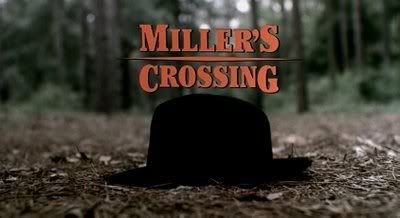
Hat in the Road


This will be the first of two posts on my weekend viewing of the Coen brother's Miller's Crossing and No Country for Old Men.

In anticipation of the Coen brother’s newest offering, No Country For Old Men, I Netflixed their 1990 violent equivalent, Miller’s Crossing, last week. Maybe it was the image of a hat lying in the middle of a road that intrigued me most, but having already seen Fargo, MC seemed like the perfect precursor to NCFOM.

Boy was my mouth open. You got me Coen brothers, you got me. I forgot I didn’t like you. Here I was sitting down on a cloudy Saturday afternoon, ready for a thought-provoking genre piece, (something along the lines of The Killers or Touchez Pas Au Grisbi) but instead got this immature posturing heap of rubbish.

Now I remember why I don’t like the Coen brothers. They don’t know what they’re talking (er, filming) about. Theirs is a cinema of appearance, providing an illusion of the truth, but not the T-r-u-t-h itself. Sure they’ll put in certain idiosyncratic details, but to no end. To them a film is a checklist. They have no understanding of simple narrative causality.

Case in point, the film’s opening scene begins with a slow pull out from a close up of a glass being filled with ice and whiskey. The sound of the ice cracking was a nice touch; I’m ready for some hat in the road. Uh oh, what’s this? The camera pulls out to a cut? No new information? Why even pull out? What?

So there’s this fat, bald guy saying something about having ethics when fixing a fight, the camera's zooming in. You can assert that the whiskey shot wasn’t his perspective, yet why the zoom in? Okay, fine, so maybe we’re watching someone else’s perspective of this fat bald guy, maybe it’s even the same perspective that the whiskey shot belongs to. Spoke too soon, it’s yet another non sequitur.

This time it’s an old man calmly listening to the fat man’s tirade. Here comes the owner of the whiskey shot walking into the background. There’s this heated exchange about so-and-so not letting so-and-so get bigger than he wants, yadda-yadda-yadda. The fat bald man leaves. So I ask, what was the purpose of that scene?

Given the opening whiskey shot, I am to presume that the film will be told from the guy pouring the drink’s perspective, which is the henchman to the calm old man. What relevance did the scene have to the henchman or the henchman to the scene? None. The Coen brothers didn’t even bother to shoot his reaction to what was going on. Why put that scene in the film?

As if to save the scene or probably just to connect it to the next, there’s this exchange between the calm old man and our protagonist where a gambling debt is alluded to and the old man offers to pay it off. Our hero declines, an obvious attempt by the Coens to instill some sort of nobility in him, but without any context who’s to say?

To tell you the truth, I slept through the rest of the film. I’m sure maybe there was some mild foreshadowing going on, that the fat bald guy was to have some role in the plot and I think I stayed awake long enough to see that our hero was sleeping with the boss’s lady, but that still doesn’t say much.

A film is not a checklist. You cannot drop plot details like you’re scattering seed, just hoping something will stick and grow in the minds of the audience. People can tell when you don’t know what you’re doing. Maybe you can fool the philistines with your appearance of a film with all its genre conventions wrapped neatly in a bow, but anyone who knows knows that film is medium of emotion, not a game of guess what the film’s doing.


TO READ THE FULL POST WITH COMMENTS, CLICK HERE
Tuesday, November 13, 2007

JP at Vienna 2007


"There are no genres in cinema, only multiple polarities (fiction, documentary, diary, experimental, essay) between which every film finds its own balance and invents its own machine." 

Retrospective & Lecture Notes from Vienna 2007
Curated by Jean-Pierre Gorin
A cooperation with the Austrian Filmmuseum, from October 1 to 31.

The film essay as a thought
The film essay is a strange beast. To simply define it as this form that foregrounds a voice and sketches a persona falls short. The essay is rumination in Nietzsche's sense of the word, the meandering of an intelligence that tries to multiply the entries and the exits into the material it has elected (or has been elected by). It is surplus, drifts, ruptures, ellipses, and double-backs. It is, in a word, thought, but because it is film it is thought that turns to emotion and back to thought. The strange thing is that as such it flirts with genres (documentary; pamphlet; fiction; diary…you name them) but never attaches itself to one. It flirts with a range of aesthetics but attaches itself to none.

"Termite Art" /vs/ "White Elephant Art"
It is both in form and content, unruliness itself, "termite art" and not "white Elephant art". I am, of course, borrowing from Manny Farber, and borrowing wholesale. Listen to Farber, and forget he might just be speaking about Laurel and Hardy, the words stick even tighter to the film essayists: "They seem to have no ambitions toward gilt culture but are involved in a kind of squandering-beaverish endeavor that isn't anywhere or for anything...The most inclusive description of [their] art is that, termite-like it feels its way through walls of particularization, with no sign that the artist has any object in mind other than eating away the immediate boundaries of his art and turning these boundaries into conditions of the next achievement."

The origins of cinema
The film essay might well be cinema's last irreducible. You find it, arguably, at the origins of cinema with A Corner in Wheat (1909), but a few years later Griffith laments the fact that cinema has turned away from filming "the rustle of the wind in the branches of the trees". Twenty years and ten days that shook the world pass, and you see it triumphant in Vertov's Chelovek s kinoapparatom (1929) but a few trials later you feel the Stalinist boot heavier by the day on its neck in Entuziazm - Simfoniya Donbassa 1931) and Tri pesni o Lenine (1934). You think it is done and over with when the oppressiveness of commercial cinema rules, but it reappears under the guise of Straub, Huillet's Trop tôt, trop tard (1981), Marker's Sans soleil (1983) or Godard's Puissance de la parole (1988). As soon as you wonder if it is after all just an ubër western mode, it becomes Asian with Oshima's Tokyo senso sengo hiwa (1970), Tahimik's Mababangong bangungot (1977) or Weerasethakul's Dogfar nai mae marn (2000). And when you want to keep it there it bounces back to the Middle East or South America…

The essay is haunting cinema
This is, of course, a fairy tale hurriedly told to infuriate academics and critics alike, and they'll accuse me, once again, of confusing everything. One fact remains though: however dire the circumstance, the essay remains alive in the margins, an Id that haunts cinema. It is never more alive than when the times are more repressive and the dominant aesthetics occupy more squarely the middle of the road. In short, it might just be a perfect time to think about it.
(Jean-Pierre Gorin)

Here are some notes on a lecture he gave:
1. There are no genres in cinema, only multiple polarities (fiction, documentary, diary, experimental, essay) between which every film finds its own balance and invents its own machine.

2. Any film worthy of the name is a machine, with its functions, its dysfunctions, its own operations. The interest of a film does not lie in its message or in its story in the literary sense, but in the operations it executes, in the articulations it keeps making and unmaking between form and meaning.

3. What sets the essay apart is its ability to unveil its own operation and articulations, more so than its subject or contents. Thus way, the image attains a special status in the essay: "it doesn't pass but it revisits itself, resisting its own temporal nature, its own passing," as Gorin writes in the catalogue that accompanies the retrospective. He also states that the essay is a form of energy, the energy of the termite, of an insect always busy digging and breaking through barriers, "an energy that constantly redefines the practice of framing, editing, mixing, freeing these from their habitual allegiance to genres."

4. Based on the kinds of operations they execute, films can be divided into two broad categories: those that tend toward unity (of message, of form) and those that try to divide, to propagate division and a dialectic - of the image, of ideas, procedures, and operations.

TO READ THE FULL POST WITH COMMENTS, CLICK HERE

A one and a two...

Photo Sharing and Video Hosting at Photobucket


This is how the perfect human dances...


TO READ THE FULL POST WITH COMMENTS, CLICK HERE
Is this the kula?

Photo Sharing and Video Hosting at Photobucket


TO READ THE FULL POST WITH COMMENTS, CLICK HERE